Categories
Bible reading Scripture

Give Paul a Break

You may be tempted to read the letters written by the Apostle Paul.

My advice: Don’t. Not yet.

Not until you’ve soaked in the Gospels for a good while. And John’s letters. And James’s letter. And Peter’s letters. And maybe a good bit of the Old Testament.

Why? It’s easy to get things all turned around otherwise.

It’s easy, because of Paul’s logic and eloquence and personal story, to make Jesus about Paul instead of Paul about Jesus.

Paul would scold us for that.

But the church has split itself into hundreds of factions because it got things turned around, mostly about what Paul wrote.

Reading Paul is like handing a dangerous chemical: if you don’t handle it carefully, it can can be deadly to you and others.

So, stick with the Gospels. And the letters of John and James and Peter. For now, anyway.

(Even Peter struggled a bit with Paul’s writings…he writes about it!)

Grace and peace to you…

dw
Categories
Bible reading Scripture

Continue continuing

Once you have read Matthew, Mark, Luke, and John…

If you find yourself wanting to move on

(maybe you’re thinking “Ok, I’ve read that bit, now let’s get to the rest of the story”

or maybe you’re not)

Don’t do it. Stay right here.

You’ve just met the person you’ve been longing to meet your whole life

And he wants to hang out.

(Maybe you remember reading “Abide with me” – that’s what he means.)

So, hang out. Read John’s gospel again. Find out more about this person, what he’s really like, who he really is.

Read slowly, hear what he is telling you. Ask questions, tell him what you think. Like you are on a walk together, or in a coffee shop.

Getting to know Jesus is the best part, the whole reason to read the Bible. As you get to know him, he’ll tell you about the rest.

You’re already where you long to be, need to be – with him.

Linger.

Grace and peace to you…
dw

p.s. Go here to see the rest of this series on reading the Bible.

Categories
Bible reading Scripture

Continue well

Once you have finished either Mark or John (referring back to Begin well…), then read the other.

Jesus did what he did because he was who he was.

He was who he was because he did what he did.

Once you have read both Mark and John, read Matthew and then Luke.

As you read, remember: the point is to know Jesus better. Look back to Resolved to read? and Does it translate? to help set that context.

dw

Categories
Bible reading

Does it translate?

“The Bible makes no sense to me.”

I think this is a common experience of all who read the Bible or who have tried and eventually put it down. If this is you, you are in good company.

Remember, the only reason to read the Bible is to know Jesus better. He is as committed to making a connection as you are. More committed. So as you reach for him, he is reaching for you.

Both of you want it to translate.

Pick a translation that reads naturally to you. Don’t struggle with an old one. If a voice in your head (or in your ear) says you should read the King James Version – heaven help us – just don’t. Period. Unless early modern English is your native language. Which it isn’t. So, none of that.

One recent translation you may want to try is called The Message by Eugene Peterson.

You might want to pray briefly and simply before you read. Something like “Jesus, I want to know you more. Help me hear what you have to say.”

Pause your reading when it feels natural. Don’t feel the need to read some prescribed amount every day. (Although there is nothing wrong with that, either.) It will translate better if you don’t feel pushed or rushed.

When you read a passage you don’t understand or that troubles you, that’s okay. Jesus has a lot to teach every one of us.

Hang in there with your thoughts and feelings. Trust that Jesus hears you, right where you are.

Maybe risk a little conversation, formulating what words you can. Listen for a response – thoughts or feelings that are new.

See, you are praying!

Grace and peace to you…

dw

Categories
Bible reading

Begin well

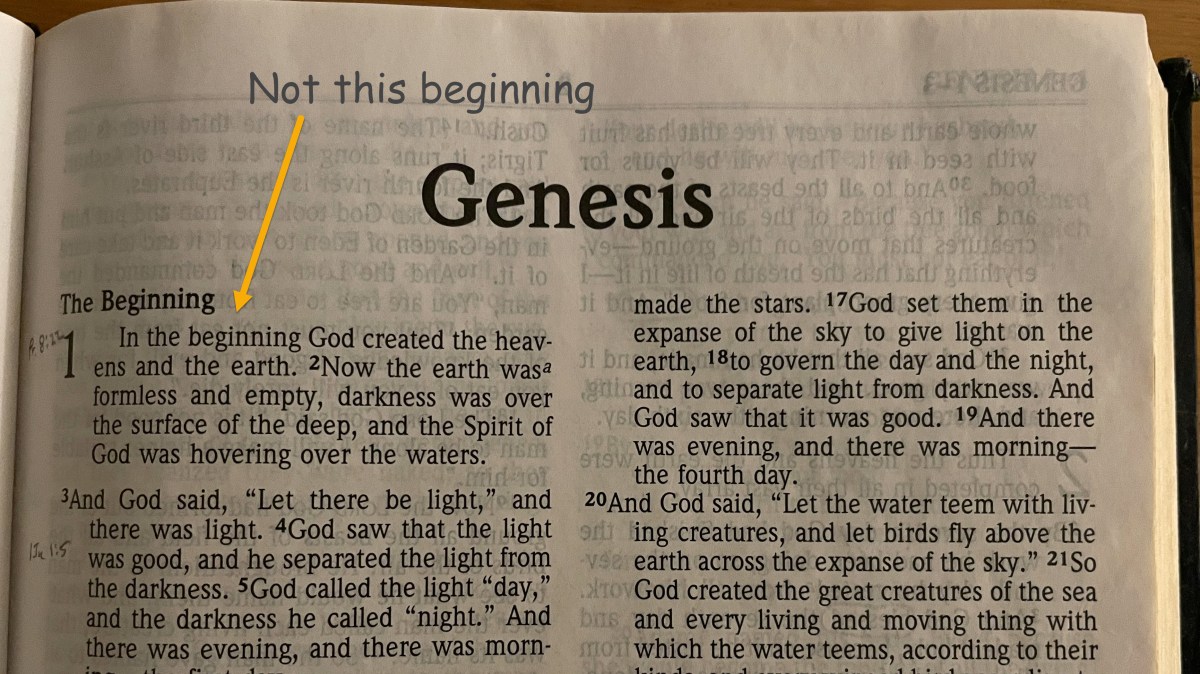
The Bible isn’t a novel. It’s not meant to be read from beginning to end.

If you “start at the very beginning”, it probably isn’t “the very best place to start.”

The Bible does have a plot, a story that develops over thousands of years. But it’s really important to know the end of the story first. Knowing the end puts all the parts in perspective.

There is no bonus for being held in suspense about how the story ends.

Remember from last week: the whole point of the Bible is to lead us to Jesus, who described himself as “the beginning and the end.” As best we can, let’s make our reading begin and end with him.

The end of the Bible is Jesus. The whole story is about him. The beginning, the middle, the end – all about him…so we can know him.

So, to begin well let’s choose one of the four Gospels. I suggest starting with John or Mark.

Start with John to focus on who Jesus is. John had an especially close relationship with him and gives us a unique perspective. John adopted Jesus’ mother Mary into his home – I wonder how much his writing passes along Mary’s reflections.

Start with Mark if you prefer to focus on what Jesus did. They say that Mark’s gospel is likely to reflect Peter’s telling of events; Peter is a “get it done” kind of person.

Which ever one you pick, don’t rush. Give yourself time to pause, question, ponder.

Most importantly, pay attention to what your inner voice might be saying. You are reading to get to know a Person, not to pass a test.

I hope you find this hodgepodge of thoughts helpful. Grace and peace to you…

dw